Best Espresso Grinder Under $300: Smart Grinder Pro vs Baratza Encore ESP vs DF54
★ The Verdict
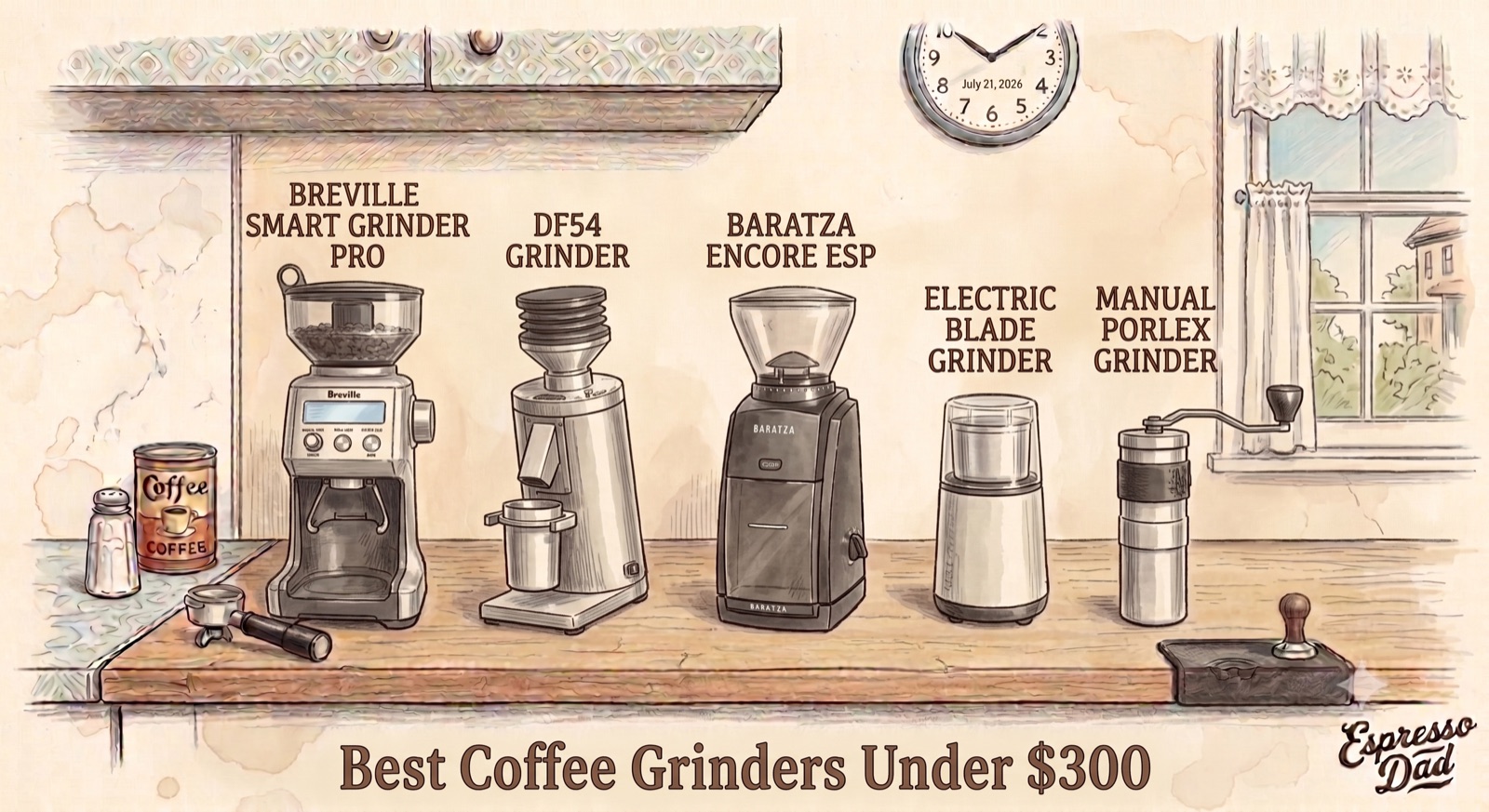
The Breville Smart Grinder Pro at $199 is the best value espresso grinder for Bambino owners and beginners. The DF54 grinds better for $30 more if you'll upgrade machines someday. The Baratza Encore ESP wins on serviceability. Skip blade grinders entirely. All three beat any blade grinder by a mile.
Your grinder and your machine both matter. But almost everyone assumes it’s the machine that makes the difference, and spends there first. Usually it’s the grinder.
Here’s the short version. Buy the Smart Grinder Pro if you own a Bambino or you’re just starting out. Buy the DF54 if you know you’ll upgrade machines someday and want the better grind now. Buy the Encore ESP if you want a grinder that lasts a decade and a company that backs it. Skip blade grinders no matter what.
I use the Smart Grinder Pro every morning, before my kids are up, the hopper rattling faintly next to the Bambino Plus while the house is still dark. The internet will tell you I should have bought something else. Here’s my honest take after six years, since 2020, compared against the two grinders everyone recommends instead, plus what to avoid and what to pack.
At a glance
| Smart Grinder ProWhat I use | DF54 | Encore ESP | Porlex | |
|---|---|---|---|---|
| Price | $199 | $229 | $199 | ~$65 |
| Burrs | 40mm conical | 54mm flat | 40mm conical | Ceramic conical |
| Dosing | Timed, digital | Single dose | Manual | Manual, hand crank |
| Retention | Moderate | Near zero | Low | Low |
| Best for | Breville owners | Future upgraders | Keep-forever buyers | Travel |
Breville Smart Grinder Pro, $199 (what I use)
60 settings, digital display, dose by time, and a design that looks like it belongs next to a Breville machine because it does.
The truth: it grinds well enough for excellent espresso on the Bambino Plus. I dial in a new bag in 2-3 shots. The digital timer means my morning dose is one button, no counting seconds in my head while I’m half asleep.
It’s also the one I reach for beyond espresso. It handles Turkish coffee and pour overs just as well, so I’m not swapping grinders depending on what I’m making.
It’s not perfect. At the very fine end the adjustments get coarse-grained, and if you someday buy a $2,000 machine, its tighter temperature and pressure control will expose more of the grind’s shortcomings, not less. That’s when you’ll feel the ceiling here. Retention is a bit high, so purge a few grams when changing settings. Small tax for a grinder this convenient, with a timer, a full set of settings dialed to the Bambino, and an easy clean between bags.
For a Bambino owner, it’s the natural pairing and the best workflow.
DF54, $229 (best pure grind)
54mm flat burrs at this price is absurd. Grind uniformity is a real step up. Single dosing with almost zero retention, so the grounds that come out are the grounds that go in the basket.
The tradeoffs: no timed dosing, so you weigh every dose. Workflow is slower. It’s a hobbyist’s grinder that rewards attention, not the one you grab at 6am with a toddler yelling from the hallway.
If you know you’ll upgrade machines within a few years, buy this now and skip a grinder upgrade later.
Baratza Encore ESP, $199 (best support)
Baratza is technically part of the same parent company as Breville now, so this isn’t a scrappy underdog story anymore. But its reputation for repairability was built well before that, and it still holds: every part is individually available, and the culture around fixing rather than replacing goes deeper than most consumer appliance brands offer, including Breville’s own consumer lines.
Grind quality is comparable to the Smart Grinder Pro. Workflow is simpler but less convenient, no timer, no display. Just a dial and a switch.
Buy it if you keep things forever and want a company built around that idea.
What I started with (and why I moved on)
My first grinder was a cheap blade grinder, the kind with spinning blades instead of burrs. It works, technically. It’s also where most people give up on espresso.
The problem is consistency. A blade grinder chops beans into whatever size it feels like that day, boulders next to dust in the same scoop. Your shot comes out watery, or sour, or bitter. Sometimes all three in the same week.
You’ll spend more time chasing a good shot than you would have spent saving up for a real burr grinder. If you already have one sitting in a cabinet, use it for drip coffee. Don’t use it for espresso.
For travel: the Porlex
The three grinders above are for the counter. They stay home. When I’m hiking or traveling with the OutIn, I bring a Porlex instead.
It’s a manual hand grinder. No cord, no batteries, small enough to fit in a bag next to a pair of socks. You crank it by hand, which takes a minute or two per dose, the grind piling up in the little catch cup while you wait for water to boil somewhere with a view.
It’s not going to replace a home grinder and it’s not trying to. But for a shot on a trail, it does the job.
Bottom line
Own a Bambino? Get the Smart Grinder Pro and enjoy the matched workflow. Planning a bigger machine someday? DF54. Want a decade of support? Encore ESP. Traveling? Porlex.
Which one matches your setup? Tell me what you’re grinding on now.
Frequently Asked Questions
Is the Breville Smart Grinder Pro good enough for espresso?
Yes. It has 60 grind settings with enough range in the fine end for espresso on machines like the Bambino Plus. It's not the last grinder you'll ever buy, but it's the right first one, and it pairs naturally with Breville machines.
What's the best espresso grinder under $300?
For most beginners, the Breville Smart Grinder Pro at $199. For the best pure grind quality under $300, the DF54 at $229 with its 54mm flat burrs. For long-term serviceability and support, the Baratza Encore ESP at $199.
Why does the grinder matter more than the espresso machine?
Espresso extraction depends on uniform particle size. An uneven grind extracts unevenly no matter how good the machine is, producing sour and bitter flavors in the same cup. A quality burr grinder is the foundation everything else sits on.
Can I use a blade grinder for espresso?
You can, but you shouldn't. Blade grinders chop beans into random sizes, from boulders to dust. That uneven grind gives you a watery, underextracted shot no matter how much time you spend dialing in. Espresso requires uniform fine particles. No technique can compensate for a blade grinder.
What's a good grinder for travel?
A manual hand grinder like the Porlex. It's small enough to pack, doesn't need power, and pairs well with a travel espresso device like the OutIn.